Most ad dashboards ask for a daily budget on the third screen, long before they have told you what a click is worth to your business. So the number gets typed in as a guess, the campaign launches, and the first weekly report becomes an argument about whether the money is “too much” or “not enough”. That is the usual starting point for Google Ads cost in Qatar: a figure picked without a method.
This guide gives you the method. You will learn what the Google Ads cost actually includes, how the price of a click is decided, what pushes it up or down, and how to work out a budget backwards from the number of customers you want. It deliberately contains no market price list, because any Google Ads cost quoted without your sector, language and goals would mislead you.
What the Google Ads cost in Qatar actually includes?
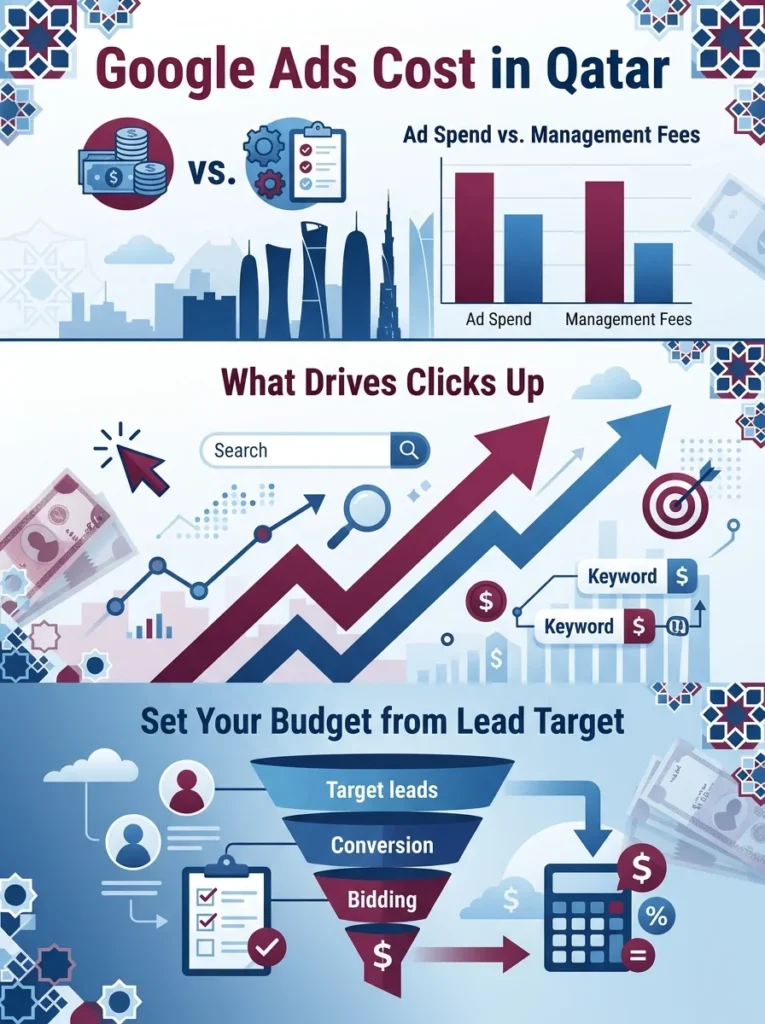
When people ask about Google Ads cost, they are usually mixing three different things. Separating them is the first step to a sensible budget, because each is paid to a different party and behaves differently.
Ad spend: what you pay Google
Ad spend is the money charged by the platform when your ads do their job. On standard search campaigns you are typically charged when someone clicks your ad, not when it is merely shown. You choose how much you are willing to spend per day, and the platform delivers within that limit. This is the part of the Google Ads cost that goes directly to advertising, and it is entirely under your control.
Management fees: what you pay a person or agency
If a specialist or agency runs the account, there is usually a separate fee for the work: setting up campaigns, researching keywords, writing ads, adjusting bids, reporting and advice. Fees can be a flat monthly amount, a percentage of spend or a mix. Ask for the structure in writing and check whether your Google Ads cost will rise automatically as your spend grows, because that changes who benefits from a bigger budget.
Everything around the ad
Ads send people somewhere, so the page they land on affects your Google Ads cost. Add the cost of a landing page if you do not have a good one, conversion tracking set up properly, and creative work such as ad copy in two languages. These are one-off or occasional costs, yet they have a large effect on how far the ad spend goes. A modest budget sent to a weak page is the most common way to waste a Google Ads cost.
How the Google Ads cost of a click is decided?
There is no fixed price list for Google Ads cost per click. Prices are set in an auction that runs every time someone searches. Advertisers who want to appear for that search compete, and the platform decides which ads show and in what order. Your bid matters, but so does how relevant and useful your ad and landing page are to the search. That is why two advertisers bidding the same amount can pay different prices, and why a well-matched ad can earn a better position for less.
This is also why anyone who quotes you a precise price per click before looking at your keywords is guessing. The Google Ads cost per click depends on the searches you target, who else wants them and how well your ads match. The platform’s own planning tools can give Google Ads cost estimates for specific keywords and locations, and it is sensible to look at those for your own terms rather than relying on someone else’s average.
What pushes Google Ads cost up or down?
Five factors explain most of the differences you will see between one account and another.
Competition for your searches
Some searches are contested by many advertisers, and some are almost empty. A crowded market pushes the Google Ads cost up because more bidders want the same visibility. A narrower market, such as a specialised service or a specific type of customer, often costs less per click, though with fewer searches. Before you set a budget, look at who is already advertising on your most important searches.
The quality of ads and landing pages
Ads that match what people are looking for, and pages that deliver what the ad promised, tend to perform better and can reduce the cost of winning a click. Vague ads and slow, confusing pages do the opposite. Improving quality is one of the few ways to lower your Google Ads cost without reducing your reach, which is why it belongs in the plan from day one.
Language, location and targeting
In Qatar, language and location choices matter. Arabic and English searches can behave very differently in volume, competition and intent, so it is worth planning and measuring them separately instead of assuming one set of keywords serves both. Targeting only Doha is a smaller audience than the whole country, and that changes how much Google Ads cost you can usefully absorb. Treat any Google Ads cost estimate as specific to the language and location you choose.
Match types and negative keywords
Keyword settings also shape Google Ads cost, because they control how closely a search must match your keyword before your ad appears. Loose settings reach more people and also attract irrelevant clicks. Negative keywords tell the platform which searches to ignore, such as free, jobs or other terms that rarely lead to customers. Disciplined keyword control is one of the most direct ways to protect your Google Ads cost from waste.
Bidding strategy and conversion tracking
Automated bidding strategies can optimise towards conversions, but they depend on accurate tracking. If the platform cannot see which clicks lead to enquiries, it optimises blindly, and the Google Ads cost per real lead rises. Setting up tracking for forms, calls and messages before launch is not optional extra work; it is part of the budget.
How to work out your Google Ads cost from a lead target?
The most useful way to plan Google Ads cost works backwards from what you want, not forwards from what feels comfortable. It runs in four simple steps: the customers you want, the enquiries needed to win them, the clicks needed to produce those enquiries, and then the spend those clicks imply, plus fees and extras. Each step is simple arithmetic that you can check with your own numbers.
Start from the sales goal, not the Google Ads cost
Begin with the customers, not the clicks. Suppose a professional-services firm wants ten new clients a month. If it closes one in four qualified enquiries, it needs about forty enquiries. If roughly one visitor in ten who clicks the ad sends an enquiry, it needs about four hundred clicks. These are placeholder values chosen to show the arithmetic, not market figures. Replace them with your own close rate and your own conversion rate.
Work backwards to clicks and spend
Now multiply the clicks by the cost per click. If a click were to cost five units of currency, four hundred clicks would need two thousand units of ad spend. Again, the five is a placeholder to demonstrate the method; the real figure comes from keyword planning tools for your terms, language and location, and from the first weeks of data. The point is that this Google Ads cost is derived from a goal, so you can judge whether it is realistic and what each lead costs.
Add the fee and the extras
Finally add the management fee, any landing-page or tracking work, and a small allowance for testing. This gives you the all-in Google Ads cost per month, and, divided by the leads you expect, a cost per lead you can compare with the value of a customer. If the cost per lead is higher than a lead is worth, the answer is not a smaller budget but a different plan: better targeting, a stronger page or a different channel.
Start small, test your Google Ads cost and then scale
You do not need to commit your full budget on day one. A sensible approach to Google Ads cost is to begin with a test budget large enough to gather meaningful data for your goal, and small enough that a wrong assumption is affordable. Run the campaign long enough to see patterns rather than reacting to a single day, and look at the cost per enquiry, not only the cost per click.
Early data will challenge your assumptions about Google Ads cost. Perhaps clicks cost more than you assumed, or fewer visitors enquire. That is useful information, and it is exactly what the test is for. Adjust one thing at a time, such as keywords, the ad, the landing page or the targeting, so you can see what changed the result. Increase the Google Ads cost gradually once cost per lead is acceptable, and keep tracking so the platform can keep learning.
Budget mistakes that waste money
Some patterns repeat across accounts and quietly raise the Google Ads cost:
- Setting a budget by feel instead of working back from a lead target.
- Launching without conversion tracking, so results cannot be judged.
- Sending clicks to a homepage instead of a page built for the ad’s promise.
- Ignoring search terms reports, so irrelevant clicks keep draining spend.
- Judging a campaign after two days, or never adjusting it after two months.
Each of these inflates the Google Ads cost without improving results, and each is avoidable with a little planning.
Questions to ask an agency about Google Ads cost
If an agency will manage the account, a few questions bring the structure of the Google Ads cost into view. Ask how the fee is calculated and whether it grows with spend. Ask what is included in set-up and what is charged separately. Ask how they will track enquiries and who owns the ad account and data. Ask how they plan to test Arabic and English separately. And ask what happens if the cost per lead is too high after the first month: what would they change, and when?
Clear answers suggest a team that treats your Google Ads cost as an investment to be managed rather than a number to be spent. For a wider view of how paid and organic channels fit together, our comparison of search ads and social ads shows when each works best, and our guide to running your first Facebook and Instagram ads campaign covers the social side.
Google Ads cost in Qatar: frequently asked questions
There is no single right minimum. What matters is whether your budget can gather enough data to judge the campaign against your goal. A very small budget on a competitive search may produce too few clicks to learn from, while a larger budget on poorly targeted keywords simply wastes more. Work backwards from your target instead of looking for a universal number.
On standard search campaigns you are typically charged when someone clicks, not when your ad is shown, so the Google Ads cost follows clicks rather than impressions. Other campaign types and bidding strategies can use different charging models, so check the model for the campaign you set up.
Google Ads budgets are usually set as a daily amount. Spending on an individual day can vary around that amount, and there are limits on total monthly spend. Check the platform’s current help pages for the exact rules before you plan around them.
It depends on your budget, your sector and how quickly enquiries arrive. You can see early signals such as clicks, click-through rate and enquiry rate within days, but judging cost per lead needs enough data. Avoid making big changes after a handful of clicks.
Often it is sensible, because search volume, competition and intent differ by language. Separate campaigns also make it easier to see what each language costs and delivers. Let your own data decide whether the split is worth keeping.
Setting your Google Ads cost with confidence
A good Google Ads cost is the one you can explain: a budget derived from a customer target, split into ad spend, fees and extras, tested in small steps and measured by cost per lead rather than cost per click. When you can trace every part of the number, you can defend it, adjust it and decide when to grow it.
If you would like help turning your own goals into a realistic budget, Creative 4 All can talk through your market and your options. Explore our pay-per-click advertising services in Qatar, or request a quote and tell us about your goals.