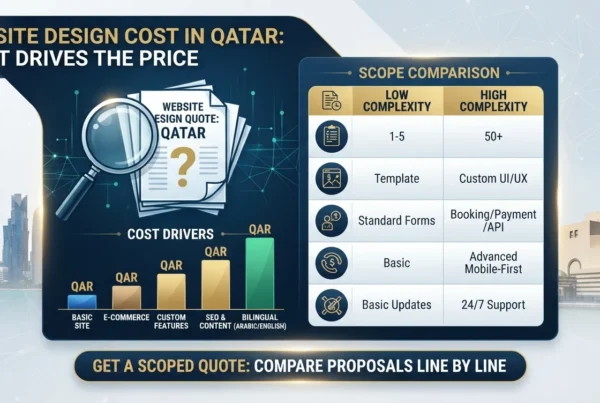
A quote for an online store usually covers the part you can see: the storefront, the product pages and the checkout. The part that decides whether the store is affordable arrives later, in monthly invoices, per-order fees and a growing list of small jobs nobody mentioned in the proposal. That gap between the launch price and the running price is the real story of online store cost in Qatar.
This guide separates the two. You will see what the build quote should contain, which costs recur after launch, how the choice between a ready-made platform and a custom build changes the online store cost, and how to turn all of it into a budget you can defend. There are no price lists here, because any online store cost quoted without your catalogue, languages and sales plans would mislead you.
Why online store cost in Qatar is more than the build quote?
It is natural to treat a store like a project with a start and an end: you pay, it launches, the spending stops. A store behaves more like a small shop that has to be kept open. Products change, prices change, orders arrive, payments are processed, parcels go out and returns come back. Every one of those activities touches the online store cost, and some of them scale with sales.
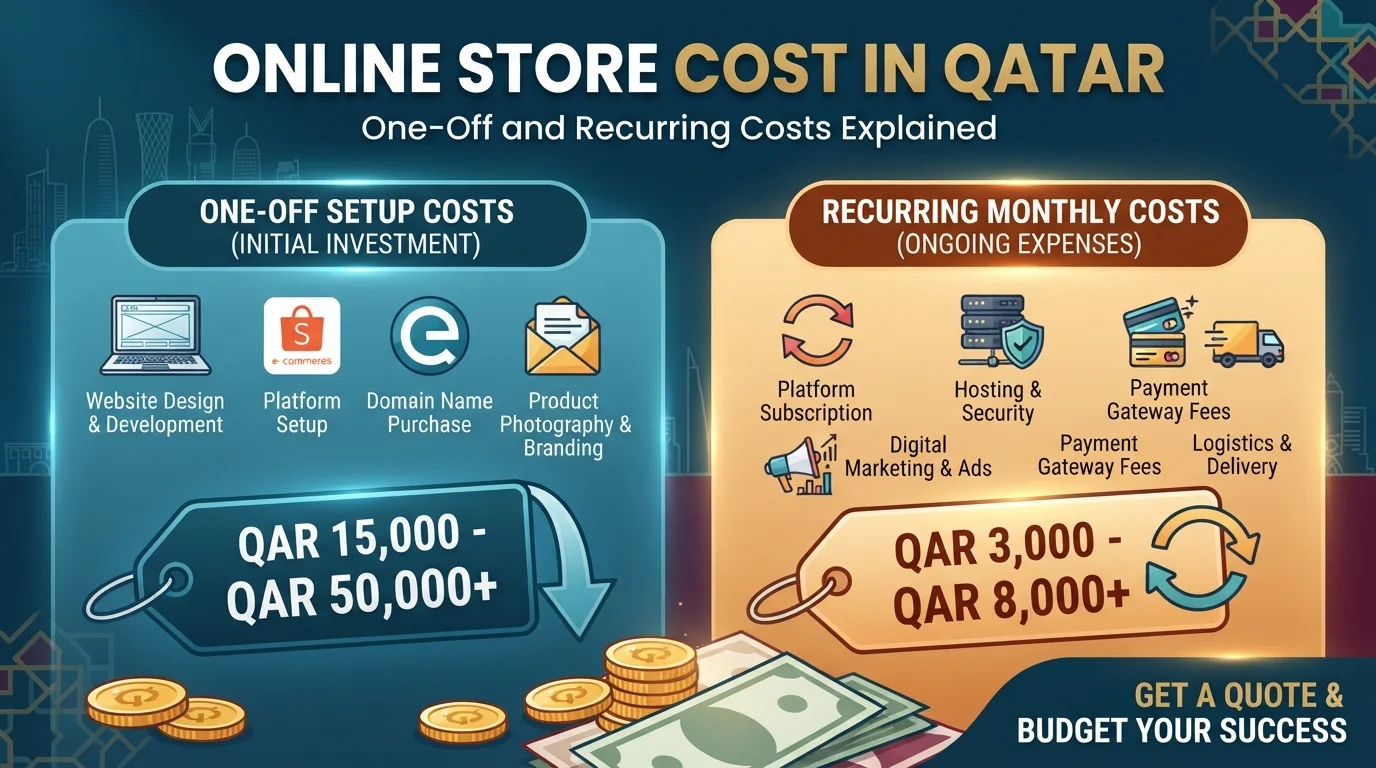
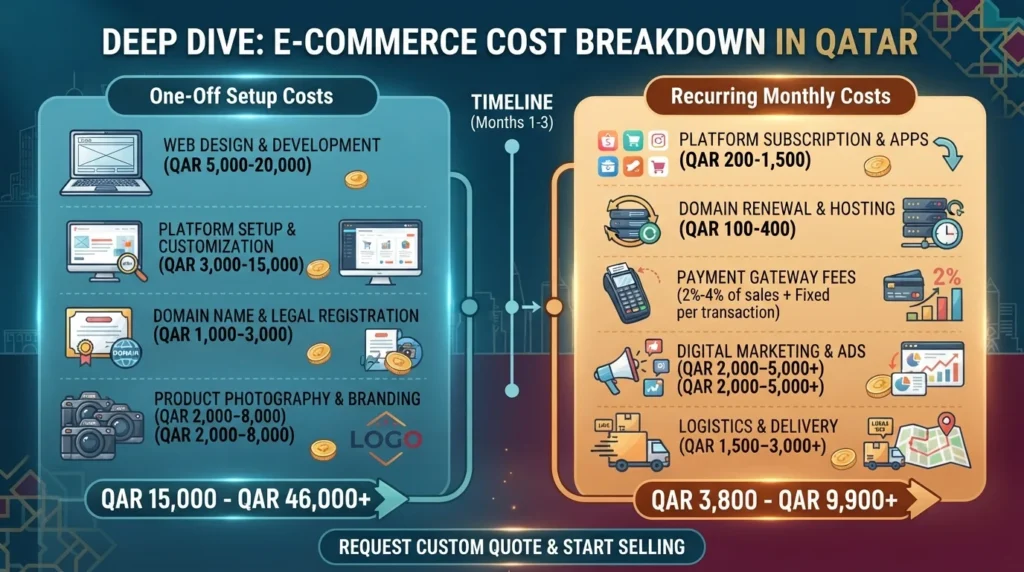
A useful way to think about online store cost is in three layers. One-off costs build the store. Recurring costs keep it running, whether or not it sells much. Variable costs rise and fall with orders, such as payment fees and shipping. A budget that includes only the first layer is a launch budget, not an online store cost budget, and that is how businesses end up surprised in month three.
Qatar adds its own considerations to online store cost. Many shops here sell in both Arabic and English, which affects content, design and customer service. Delivery and payment arrangements differ from one business to another, and some stores connect to existing stock or accounting systems. None of this is unusual, but each element belongs on the list before you ask for quotes.
The one-off online store cost: what building involves
One-off online store costs are the ones you will see on a proposal. They are also the ones most easily compared, provided each quote describes the same scope.
Design and storefront
Design covers how the store looks and how shoppers move from the homepage to the checkout: layout, product page templates, mobile views and branding. A store built from a ready-made theme usually costs less to design than one designed from scratch, though heavy customisation can close the gap. Ask how many page templates are included, because product pages, category pages and the cart each need attention, and each adds to the online store cost.
Development and features
Development turns the design into a working store. It includes setting up the platform, building any custom features, connecting a content management system and making the store fast and secure. Features beyond the basics, such as discount rules, wish lists, customer accounts, subscriptions or product bundles, each add effort and online store cost. A proposal that names features individually is easier to trust than one that promises “all the functionality you need”.
Catalogue set-up: the hidden online store cost
Products do not appear on their own. Someone has to enter them, with photos, descriptions, prices, variants and categories. For a large catalogue, this can be one of the biggest parts of the online store cost, and it is frequently left out of the quote. If your products need Arabic and English descriptions, the effort doubles. Ask whether data import, copywriting and photography are included, who does them and how you will review the results.
Payments, shipping and integrations
Connecting a payment provider, setting up shipping rules and linking to other systems such as stock control, accounting or a customer database are separate pieces of work. Each integration needs configuration and testing, and some come with their own licence or set-up fee. Confirm which providers and systems are covered in the quote, and check availability and requirements directly with each provider, since these details change.
Testing and launch
A professional launch includes testing the whole purchase journey on different devices, placing test orders, checking emails and receipts, and verifying tracking. It also includes redirects if you are replacing an older site and training for your team. These steps rarely feel urgent in a proposal, yet skipping them is how stores launch with broken checkouts. Check that testing and training appear as lines in the scope.
The recurring online store cost after launch
Once the store is live, a second set of online store costs starts. These are easier to forecast than most people expect, if you ask the right questions.
Platform, hosting and licences
Most stores carry a recurring online store cost for the platform, the hosting or both. Some platforms charge a subscription, some charge by plan level, and some use free software but require paid hosting and extensions. Renewals for the domain, the security certificate and any premium plugins add to the list. Our guide on who should own your domain, hosting and ad accounts explains why these accounts should be in your business name, so renewals do not become a dispute later.
Payment and transaction fees
Payment providers usually charge for processing orders, often as a percentage of each sale, sometimes with a fixed fee per transaction, and sometimes with set-up or monthly charges. Because these fees scale with sales, they rise as the store succeeds. Confirm the structure with each provider you consider, and include it in your forecast as a variable online store cost, not an afterthought.
Maintenance, security and updates
Software needs updates, backups and security monitoring. Someone has to apply them, whether through a maintenance plan with an agency or through in-house time. Ask what a maintenance plan includes, how quickly problems are fixed and what is charged separately. This line of the online store cost is easy to ignore before launch and expensive to regret afterwards.
Marketing and traffic
A store that nobody can find does not sell. Search optimisation, paid advertising, email, social media and content all cost money or time. These are not part of the build, but they belong in a realistic online store cost forecast, because the best-designed store earns nothing without visitors.
Operations: shipping, returns and customer service
Packaging, delivery, returns handling and customer enquiries are operational costs that grow with orders. They sit outside the website budget, yet they shape whether each sale is profitable, so include them when you assess the whole online store cost picture.
Ready-made platform or custom build: how it changes online store cost
The platform decision affects both the one-off and the recurring costs. A ready-made platform can lower the up-front online store cost because the core is already built, and it often brings a predictable subscription. The trade-offs are less flexibility, platform fees that may grow with your sales and reliance on the platform’s extension ecosystem.
A custom build usually raises the up-front online store cost, because more of the store is created from scratch. In return it can fit unusual requirements, integrate deeply with your systems and avoid some platform fees. It also puts more responsibility on you or your agency for hosting, security and updates, which shows up in the recurring costs.
Neither route automatically has the lower online store cost over several years. The honest comparison looks at a twelve-month or three-year total, including subscriptions, development hours for changes and the transaction fees each route implies. Ask each agency to price your actual requirements on both routes before you decide, and confirm which platforms it builds on before assuming they are available.
What a bilingual shop adds to online store cost?
Selling in Arabic and English is common and often worthwhile, but it adds to online store cost. Product descriptions, category pages, policies, emails and customer messages all need both languages. Right-to-left layouts must be designed and tested, not simply mirrored. Search results, filters and navigation need to behave correctly in each language, and customer service needs people who can reply in both.
The first translation is only the beginning. Every new product, every price change and every promotion creates content work in two languages, so bilingual selling adds a recurring component to the online store cost. Decide early whether both languages launch together or one follows, and ask each agency how it handles content updates in both languages.
How to build your online store cost budget?
A good online store cost budget starts from a clear structure. Divide your expected online store cost into one-off, recurring and variable, then estimate each with real quotes and real provider terms. The variable layer is where a simple example helps.
Suppose a store expects one hundred orders a month, each worth one hundred units of currency. If a payment provider charged three percent per order, the fee would be three hundred units a month. The three percent is a placeholder to demonstrate the arithmetic, not a market rate; use the actual terms from your provider. The point is that this part of the online store cost grows with every sale, so it belongs in your margin calculation, not in the build budget.
Then add the recurring items: platform, hosting, maintenance and marketing. Multiply by twelve to see a yearly running cost, and add the one-off build to see a first-year total. Compare that figure with your expected revenue and margins. If the first-year online store cost looks heavy, adjust the plan before you build: launch with a smaller catalogue, fewer features or one language first, rather than cutting testing or maintenance. Our online store launch checklist is a useful companion for deciding what must be ready on day one.
How to compare two online store quotes?
The most reliable way to compare online store cost between quotes is to make each one answer the same questions. Build a table with one row per cost item and one column per quote, and mark what is included, what is extra and what is not mentioned.
An illustrative example, not a real case: a boutique plans a bilingual store with about two hundred products. Quote A gives one total for “online store development”. Quote B itemises design, development, product import, payment and shipping set-up, testing and training, and lists the recurring items separately. Quote C is the most detailed and also covers Arabic content entry, a maintenance plan and a first month of support after launch.
Quote A looks like the lowest online store cost, but it does not say whether the products, the Arabic content or the payment set-up are included. Quote B is clearer yet silent on maintenance. Quote C is the only one where the first-year picture can be built. If the other two were asked to match its detail and their totals rose, the lesson would be that the first numbers were incomplete, not cheaper. A good brief helps every agency quote the same job, and our guide to writing a website brief shows how to prepare one.
Warning signs in online store quotes
A few patterns deserve a second look before you commit:
- A single total with no breakdown of what the store includes.
- No mention of product entry, Arabic content, testing or training.
- Recurring costs such as hosting, licences or maintenance left unstated.
- The domain, hosting or store accounts registered to the agency rather than to you.
- Pressure to sign immediately because a price is “only available this week”.
None of these proves bad intent. Each signals that the online store cost has not yet been described in enough detail to rely on, and a good agency will welcome the chance to add it.
Questions to ask before you sign
A handful of direct questions about online store cost bring most gaps to the surface. Ask which costs are one-off and which recur, and what the likely twelve-month total is. Ask whether product entry, content and photography are included. Ask how payment and shipping integrations are priced and who maintains them. Ask what maintenance covers and what happens when something breaks. Ask who owns the store, its code and its accounts. And ask what the process is for adding features later, so growth does not mean starting again.
Online store cost in Qatar: frequently asked questions
Plan a separate running budget for platform and hosting, payment fees, maintenance, marketing and operations, and review it against expected sales. There is no universal percentage; the right figure depends on your platform, your volume and how much work you do in-house.
Not necessarily. A low build price can hide recurring fees, missing content or weak foundations that cost more to fix later. Compare the first-year and three-year totals, not just the launch invoice, when you judge online store cost.
Often yes, through your payment provider and sometimes through the platform. The structure varies, so ask each provider for its current terms and include them in your margin calculation.
Yes, and it is often sensible. A phased plan keeps the initial online store cost manageable, as long as the foundations support growth and the quote explains how later features will be priced.
Most stores begin with a well-built, mobile-friendly website. An app adds development, maintenance and promotion costs, so it makes sense only when you have clear reasons and an audience likely to use it.
Getting online store cost right
A fair online store cost is the sum of three clear layers: what it takes to build the store, what it takes to keep it running and what rises as it sells. Quotes worth trusting describe all three, so you can see the first year before you commit.
If you would like a scoped view of what your own store would involve, Creative 4 All can talk through your catalogue, languages and plans. Learn more about our e-commerce development services in Qatar, or request a quote and tell us about your store.