
Most small businesses do not lack marketing activity. They lack a plan that connects the activity. A post goes out on Monday, a Google Ads campaign starts on Wednesday, someone updates the website on Friday, and by the end of the month nobody can say which of those things produced an enquiry. A digital marketing plan fixes that by deciding, in advance, what you are trying to achieve, who you are trying to reach and how you will know it worked.
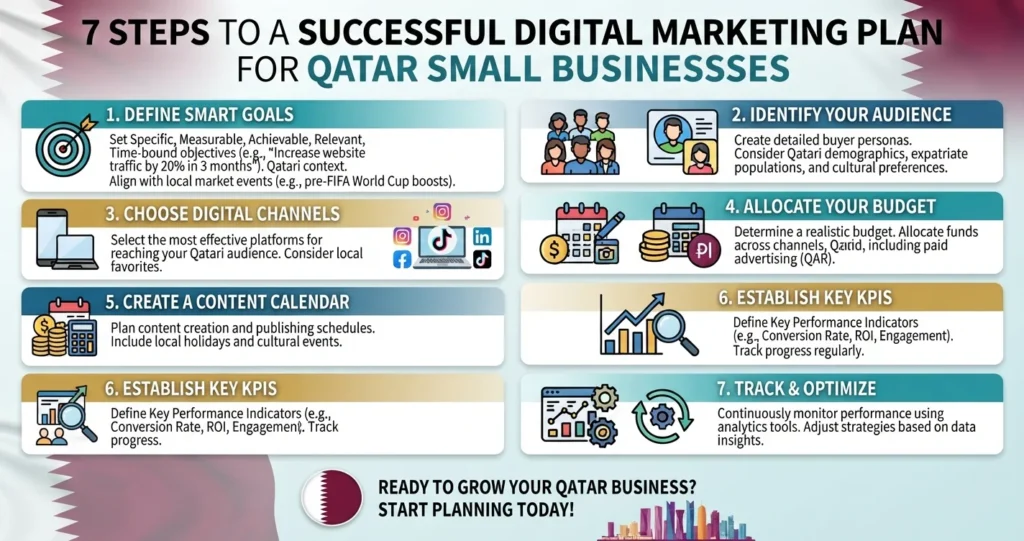
This guide walks through a digital marketing plan for a small business in Qatar in seven steps, from goals to review. It ends with a one-page digital marketing plan template you can copy and fill in, plus a worked example. Nothing here depends on a large budget or a large team, and nothing relies on invented benchmarks: every number in the plan is one you will set from your own business.
What a digital marketing plan should contain?
A good digital marketing plan is shorter than most people expect. It answers six questions: what do we want, from whom, through which channels, with what budget, on what schedule and measured how? If your digital marketing plan answers those six questions on a single page, it is useful. If it runs to forty pages and does not, it is a document, not a plan.
A digital marketing plan is also a working tool, not a trophy. It should change when your numbers change. A quarterly review is enough to keep it honest, and a monthly check keeps the day-to-day work on track.
People often confuse a digital marketing plan with a content calendar or a list of tactics. A content calendar says what will be published; a digital marketing plan explains why, for whom and how success will be judged. Keep them separate: the calendar is one part of the digital marketing plan, not a substitute for it.
Step 1: Set goals for your digital marketing plan
Everything in a digital marketing plan flows from the goal, so write it in business terms before you write it in marketing terms. “More followers” is a marketing goal. “Ten new clients a month” or “two hundred online orders a month” is a business goal. The first can be hit without helping you at all; the second tells you whether marketing is paying for itself.
Choose one or two primary goals for your digital marketing plan, such as more qualified enquiries, more online sales or more bookings. Then add a supporting goal if it matters, such as stronger Arabic visibility or a better repeat-customer rate. Resist the urge to list ten goals. A digital marketing plan with too many priorities has none.
Put numbers on each goal, using your own history. If you have never tracked enquiries, your first target is simply to start tracking them, and your second is to improve on that baseline. Inventing a figure from an industry average makes the digital marketing plan look impressive and the review meaningless.
Step 2: Define your audience and your markets
Next, describe who your digital marketing plan is trying to reach. For a service business, that might be owners of small companies in Doha who need a particular service. For a shop, it might be customers across Qatar who buy a certain type of product. Write down what they are trying to solve, what they search for and where they spend time online.
In Qatar, two decisions deserve explicit attention. The first is language. Arabic and English audiences often search differently, follow different accounts and respond to different messages, so your digital marketing plan should say which language each activity serves. Our guide to Arabic keyword research explains why Arabic searches deserve their own research, not a translation of the English ones.
The second is geography. Decide whether you are targeting Doha, the whole country or the wider Gulf, and keep the digital marketing plan consistent with that choice. A narrower focus usually makes a small budget go further, and you can widen later when the results justify it.
Step 3: Choose the channels for your digital marketing plan
A channel is a place where you reach people: search results, social platforms, email, your own website, messaging apps. The mistake is to try them all. A small digital marketing plan works best with two or three channels chosen deliberately, each with a job to do.
Search: organic and paid
When people already search for what you sell, search is usually the most direct route to an enquiry. Organic search through SEO builds visibility over time, while paid search can produce results sooner at a cost per click. Many businesses use both, with paid search covering the gap while organic visibility grows. If you need help choosing between them, our comparison of search ads and social ads sets out when each fits, and a free business listing is a sensible local starting point, as explained in our guide to the Google Business Profile.
Social media
Social platforms suit businesses whose products are visual, whose customers browse before they buy or who benefit from staying visible. They work less well as a standalone enquiry channel for complex services, where the relationship usually starts with a search. If you plan paid social, our guide to running your first Facebook and Instagram ads campaign is a practical starting point.
Email and messaging
Email and messaging apps are channels you own: the people on your list chose to hear from you. They are inexpensive to run and valuable for repeat business, reminders and follow-up. A digital marketing plan should say how you will collect contacts, with consent, and what you will send them.
Your website
The website is the hub that every other channel points to, so the digital marketing plan must cover it: the pages that convert, the forms and calls to action, and what happens after someone enquires. Channels cannot compensate for a site that does not turn visitors into enquiries.
Step 4: Set a budget you can defend
A digital marketing plan needs a budget, and the safest way to set one is to work backwards from your goal. Start from the number of customers you want, estimate how many enquiries you need to win them and how much traffic you need to produce those enquiries, then cost the channels that would deliver it. Add the cost of any agency, tools and creative work.
Do not borrow a percentage from an article, including this one. Percentages describe other businesses, not yours. A digital marketing plan budget built from your own targets can be explained, tested and adjusted, which is what makes it useful. Start with a test budget if you are unsure, run it long enough to see patterns and increase it when the cost per enquiry is acceptable.
Step 5: Build a content and campaign calendar
A calendar turns the digital marketing plan into action. List what will be published or launched each month: website updates, articles, ads, emails, social posts and any promotions. Assign an owner and a date to each item, and leave room for the unexpected.
Seasonality matters in Qatar. Ramadan and Eid change when people browse and buy, and campaigns that work in other months can fall flat or need a different tone. Build these periods into the digital marketing plan early, ideally a few weeks ahead, and use our guide to planning Ramadan and Eid campaigns to avoid last-minute rushes. Check the dates for the year you are planning, since they shift annually.
A realistic calendar also reflects capacity. It is better to publish one useful piece a week for a year than five pieces in a burst and then nothing. Match the calendar to the people and hours you have.
Step 6: Track results with a few metrics
A digital marketing plan is only as good as its measurement. Choose a small set of metrics tied to your goals. For enquiries, that might be the number of form submissions, calls and messages, and the cost of each. For sales, it might be orders, revenue and the cost of acquiring a customer. For visibility, it might be impressions and clicks from search.
Set up tracking before you launch, not after. That means connecting your analytics, making sure forms and calls are recorded and, if you advertise, tracking conversions. Review the numbers on a fixed rhythm and write down what you learned and what you will change. A metric nobody acts on is just a chart.
Step 7: Review, learn and adjust
The last step is the one most digital marketing plans skip. Every month, look at what happened against the goals, and every quarter, ask whether the plan itself still makes sense. If a channel is producing enquiries at a good cost, put more behind it. If one is not working after a fair test, change the approach or stop. A digital marketing plan that never changes is not being used.
Keep the review honest and simple: what worked, what did not, what we will do next. Fifteen minutes with the right people, on a fixed date, beats an annual strategy workshop.
A digital marketing plan template you can copy
Here is a one-page digital marketing plan structure you can paste into a document and fill in. Keep each answer to a sentence or two:
- Goal: the business result we want and by when, based on our own numbers.
- Audience and language: who we are reaching, in which markets, in Arabic, English or both.
- Channels: the two or three channels we will use, and the job each one does.
- Budget and owner: what we will spend per month and who is responsible.
- Calendar and metrics: what happens each month, how we will measure it and when we will review.
Add a short section at the bottom for assumptions, such as the close rate and conversion rates you are using, so the next review can test them against reality.
A worked example: a bilingual professional-services firm
The example below is illustrative, not a real client case, and it uses no real figures. Imagine a small consultancy in Doha with an Arabic and English website. Its digital marketing plan sets one goal: more qualified enquiries from small and medium businesses. It describes the audience as owners and managers who search for the service in both languages. It chooses three channels: organic search for informational and service searches in both languages, paid search for its most valuable service, and email for existing contacts.
The budget is worked backwards from the number of clients it wants, and the calendar schedules one useful article per week alternating languages, a quarterly email and a campaign timed away from Ramadan. Metrics are enquiries by channel and language, cost per enquiry for paid search and impressions for organic. A fifteen-minute monthly review decides what to repeat and what to drop. The digital marketing plan fits on one page, which is exactly why it gets used.
Common mistakes to avoid
Several patterns weaken a digital marketing plan before it starts. Choosing channels before goals leads to activity without direction. Copying a competitor’s tactics ignores that their audience, budget and goals differ. Launching without tracking makes results impossible to judge. Treating Arabic as a translation job rather than a separate audience risks missing a large part of your market. And writing the plan once and filing it away guarantees it will be out of date within a quarter.
Digital marketing plan: frequently asked questions
A digital marketing plan should be as short as it can be while still answering the six core questions. For most small businesses, one page of decisions plus a calendar and a simple metrics table is enough. A longer document can sit behind it if you need detail.
Review results monthly and revisit the digital marketing plan itself every quarter. Update it sooner if your goals, budget or market change, or if a channel clearly under- or over-performs.
Not necessarily. You can build the first version of your digital marketing plan yourself using the steps above. An agency can help with research, channel strategy, tracking and execution, especially if you lack time or in-house skills.
Start where your customers already look for what you sell. For many service businesses that is search, while for visual or impulse products it may be social. Test one or two channels properly instead of spreading a small budget across five.
If your customers use both languages, yes. Treat each language as its own audience, with its own keywords, messages and measurement, and let the data show where to invest more.
Put your digital marketing plan into action
A digital marketing plan is a set of decisions you can explain on one page: the goal, the audience, the channels, the budget, the calendar and the metrics. Make those decisions deliberately, review them regularly and change them when the evidence says so.
If you would like help turning your own goals into a practical plan, Creative 4 All can talk through your market and your options. Learn more about our digital marketing services in Qatar, or request a quote and tell us about your business.